

Thursday, 22 June 2023

Wednesday, 14 June 2023
Here are the details of the next elections course, and the dates for the mentoring sessions, I hope you’ll be able to join me.
Introduction to Traditional Elections
This short course of 4 classes over 4 weeks, offers an introduction to the magical art of elections - choosing the golden moment. We will begin with the theory, rules, method, and mindset; in the next class we will work together through ‘mock’ elections that I will provide; the final two classes will offer you the opportunity of working with your own charts to propose your own ‘mock’ elections - we will work through these together. Full details will be provided nearer the time. This course is intended to show how the process works, but each election is unique, which is why this course is intended as an introduction to that uniqueness.
This course is aimed at those who have some familiarity with traditional astrology, and horary astrology preferably. Otherwise, please contact me initially.
All classes begin at 2.30pm BST:
Saturday 15 July 2023;
Saturday 22 July 2023;
Saturday 29 July 2023;
Saturday 5 August 2023.
Each class will be between 1.5 and 2 hours in length and will be recorded and made available to enrolled students.
The fee is £160.00.
Chart mentoring sessions
All are at 2.30 pm BST:
Sunday 2 July 2023;
Sunday 6 August 2023;
Sunday 3 September 2023;
Sunday 1 October 2023.
Please contact me at suewardhorary@icloud.com and find details of this and my other courses at sue-ward.co.uk
Wednesday, 17 May 2023
NEW COURSE
The Introduction to Traditional Mundane Astrology
The purpose of this course is to introduce you to the fundamentals of this very important facet of astrology. You will learn how to approach the various phenomena and their charts through the conjunctions of 1981 and 2000, and then apply that theory to the 2020 conjunction and its satellite charts; culminating in an examination of the connections with the coronation of Charles III. We shall use the charts of the conjunctions, eclipses, lunations, and ingresses as appropriate to achieve our results. The traditional methods used differ from what you might expect but produce accurate results when properly applied.
All charts are provided along with some study material. This is an advanced course using traditional methods, students should be able to use an ephemeris and handle more than one chart at a time.
The course is of 6 live consecutive weekly classes of 1.5 to 2 hours’ duration, all begin at 2.30pm BST and recordings made available after each class.
- Saturday, 3 June 2023 Class 1: how to judge the Saturn-Jupiter conjunction;
- Saturday, 10 June 2023 Class 2: how to judge eclipses in the mundane context;
- Saturday, 17 June 2023 Class 3: how to judge ingresses in the mundane context;
- Saturday, 24 June to 8 July 2023 Classes 4-6 incl.: applying the theory to the 2020 conjunction and its satellite charts. Finally, an examination of the appropriate royal charts will tell us about the reign of Charles III.
Full details can be found at www.sue-ward.co.uk or contact me suewardhorary@icloud.com .
Tuesday, 29 November 2022
Another Announcement
I’m delighted to announce the publication of my latest book Horary Astrology, Abduction & Murder: the horary method applied to 16 cases.

It is an informal demonstration of how the traditional horary method can be applied in such extreme and tragic circumstances and explains the best methods of approaching these situations. It is a slim volume, but I hope that you’ll find that quality surpasses quantity! Worked examples of this kind are uncommon and I hope that you will find them of value.
https://www.prismaedicoes.com/livro/aa-2022-swhaam-en
UK www.amazon.co.uk/dp/B0BM4JPXQT
US www.amazon.com/dp/B0BM4JPXQT
Spain (closest market to Portugal) www.amazon.es/dp/B0BM4JPXQT
Friday, 14 October 2022
I am very pleased to announce two new learning opportunities with me.
Introduction to Traditional Elections
This short course of 4 classes over 4 weeks, offers an introduction to the magical art of elections - choosing the golden moment. We will begin with the theory, rules, method, and mindset; in the next class we will work together through ‘mock’ elections that I will provide; the final two classes will offer you the opportunity of working with your own charts to propose your own ‘mock’ elections - we will work through these together. Full details will be provided nearer the time. This course is intended to show how the process works, but each election is unique, which is why this course is intended as an introduction to that uniqueness.
This is an advanced level course meant for those who have some familiarity with traditional astrology, and horary astrology preferably. Otherwise, please contact me initially for advice on prerequisite reading.
The first class will be on Saturday 29 October 2022 beginning at 2.30pm BST; each class will be between 1.5 and 2 hours in length.
Chart Mentoring
These ‘pop up’ single mentoring sessions are primarily intended for those who have previously studied with me and therefore understand the processes of traditional horary practice. However, if anyone else is interested, you should contact me in the first instance and we’ll see what we can arrange.
Bring the charts that have puzzled you or have caused you a problem; we can discuss them in these sessions with some charts that I will provide. The purpose of these sessions is to provide some extra experience in chart judgement and are not intended as tuition; these are practice sessions.
The first session will be on Sunday 30 October 2022 at 2.30pm GMT for approximately 2 hours.
Please contact me at suewardhorary@icloud.com to register or for further information.
Saturday, 3 September 2022
Sue Ward Talking Horary I & II
A year ago, in these two workshops, I showed some hints and tips for judging horary questions in varying contexts. Questions about marriage, inheritance, love, career, health, buying land, lost animals, theft, politics, absent husbands, moving house, fugitives, war, and death were examined with participants. These videos are now available to purchase.
Full details available at sue-ward.co.uk
Sunday, 14 August 2022
Announcement
It’s that time again!
Enrolments are now being taken for The Traditional Horary Course, which is available in its new format of liveonline classes beginning on 6 September 2022.
Details of classes and syllabus are available at www.sue-ward.co.uk
Enquiries to suewardhorary@icloud.com
Its accompanying textbook, Sue Ward’s Traditional Horary Course, is available at Amazon (ISBN: 9798477494156), link below. Over 350 pages of lessons and example charts which form an encyclopaedic explanation of the techniques of William Lilly’s teaching and practice. (See also Sue Ward’s Collected Essays, link follows.)
An excellent resource for all astrologers not only enrolled students.
There is a video launch of the course in 2021 and book accessible now on my YouTube channel (suewardastrologer) that offers some extra information. https://youtu.be/JxCOSXFVIcw
I’m looking forward to working with you.

Also available now in Australia, UK, Germany, France, Spain, Canada, Italy, Japan.
And:
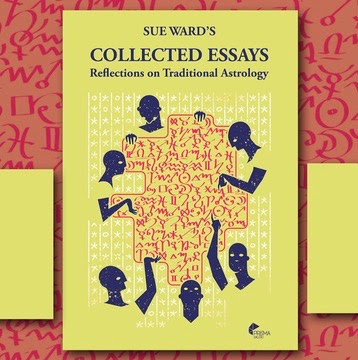
https://tinyurl.com/2p8ncyvy
Subscribe to:
Posts (Atom)


